
Given a binary tree with the following rules:
root.val == 0- For any
treeNode:- If
treeNode.valhas a valuexandtreeNode.left != null, thentreeNode.left.val == 2 * x + 1 - If
treeNode.valhas a valuexandtreeNode.right != null, thentreeNode.right.val == 2 * x + 2
- If
Now the binary tree is contaminated, which means all treeNode.val have been changed to -1.
Implement the FindElements class:
FindElements(TreeNode* root)Initializes the object with a contaminated binary tree and recovers it.bool find(int target)Returnstrueif thetargetvalue exists in the recovered binary tree.
Example 1:
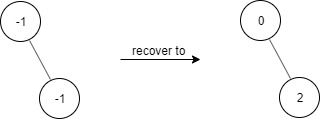
Input
["FindElements","find","find"]
[[[-1,null,-1]],[1],[2]]
Output
[null,false,true]
Explanation
FindElements findElements = new FindElements([-1,null,-1]);
findElements.find(1); // return False
findElements.find(2); // return True
Example 2:
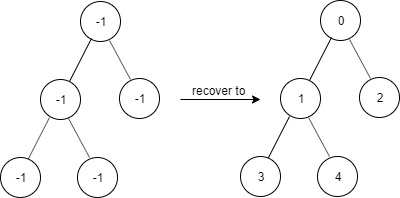
Input
["FindElements","find","find","find"]
[[[-1,-1,-1,-1,-1]],[1],[3],[5]]
Output
[null,true,true,false]
Explanation
FindElements findElements = new FindElements([-1,-1,-1,-1,-1]);
findElements.find(1); // return True
findElements.find(3); // return True
findElements.find(5); // return False
Example 3:
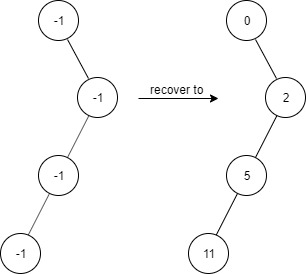
Input
["FindElements","find","find","find","find"]
[[[-1,null,-1,-1,null,-1]],[2],[3],[4],[5]]
Output
[null,true,false,false,true]
Explanation
FindElements findElements = new FindElements([-1,null,-1,-1,null,-1]);
findElements.find(2); // return True
findElements.find(3); // return False
findElements.find(4); // return False
findElements.find(5); // return True
Constraints:
TreeNode.val == -1- The height of the binary tree is less than or equal to
20 - The total number of nodes is between
[1, 104] - Total calls of
find()is between[1, 104] 0 <= target <= 106
Approach 01
-
C++
-
Python
class FindElements {
public:
    FindElements(TreeNode* root) {
        dfs(root,0);
    }

    bool find(int target) {
        return result.contains(target);
    }

private:
    unordered_set<int> result;

    void dfs(TreeNode* root, int value){
        if(root==nullptr){
            return;
        }
        root->val = value;
        result.insert(value);
        dfs(root->left, value*2+1);
        dfs(root->right, value*2+2);
    }
};
class FindElements:

    def __init__(self, root: Optional[TreeNode]):
        self.result=set()
        self.dfs(root, 0)

    def find(self, target: int) -> bool:
        return target in self.result

    def dfs(self, root: TreeNode | None, value: int)->None:
        if(root is None):
            return

        root.val = value
        self.result.add(value)
        self.dfs(root.left, root.val*2+1)
        self.dfs(root.right, root.val*2+2)
Time Complexity:
- Tree Reconstruction:
During the
dfstraversal, each node is visited once, leading to a time complexity of \( O(n) \), where \( n \) is the number of nodes in the tree. - Insertion into
unordered_set:Each insertion operation in
unordered_settakes \( O(1) \) on average, resulting in a total of \( O(n) \) for storing all nodes. - Find Operation:
Checking the presence of an element in
unordered_setis an average \( O(1) \) operation. - Total Time Complexity:
The overall complexity is \( O(n) \) for construction and \( O(1) \) for each
findquery.
Space Complexity:
- Tree Storage:
The
unordered_setstores at most \( O(n) \) elements. - Recursive Stack:
In the worst case (a skewed tree), the recursion depth is \( O(n) \), leading to an additional \( O(n) \) space usage.
- Total Space Complexity:
The overall space complexity is \( O(n) \).