
Given the head of a linked list, remove the nth node from the end of the list and return its head.
Example 1:
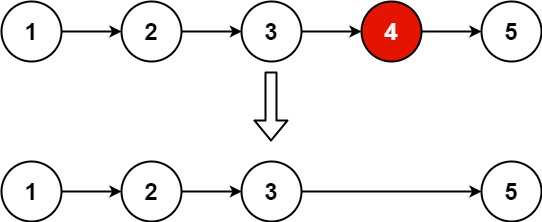
Input: head = [1,2,3,4,5], n = 2
Output: [1,2,3,5]
Example 2:
Input: head = [1], n = 1
Output: []
Example 3:
Input: head = [1,2], n = 1
Output: [1]
Constraints:
- The number of nodes in the list is
sz. 1 <= sz <= 300 <= Node.val <= 1001 <= n <= sz
Follow up: Could you do this in one pass?
Approach 01: Two Pointers (One Pass)
/**
 * Definition for singly-linked list.
 * struct ListNode {
 *     int val;
 *     ListNode *next;
 *     ListNode() : val(0), next(nullptr) {}
 *     ListNode(int x) : val(x), next(nullptr) {}
 *     ListNode(int x, ListNode *next) : val(x), next(next) {}
 * };
 */
class Solution {
public:
    ListNode* removeNthFromEnd(ListNode* head, int n) {
        ListNode* dummy = new ListNode(0, head);
        ListNode* first = dummy;
        ListNode* second = dummy;
        for (int i = 0; i <= n; i++) {
            first = first->next;
        }
        while (first != nullptr) {
            first = first->next;
            second = second->next;
        }
        second->next = second->next->next;
        return dummy->next;
    }
};
Time Complexity:
- O(L): where L is the number of nodes in the list. One pass.
Space Complexity:
- O(1): Constant space used.
# Definition for singly-linked list.
# class ListNode:
#     def __init__(self, val=0, next=None):
#         self.val = val
#         self.next = next
class Solution:
    def removeNthFromEnd(self, head: Optional[ListNode], n: int) -> Optional[ListNode]:
        dummy = ListNode(0, head)
        first = dummy
        second = dummy
        for i in range(n + 1):
            first = first.next
        while first:
            first = first.next
            second = second.next
        second.next = second.next.next
        return dummy.next
Time Complexity:
- O(L): where L is the number of nodes in the list. One pass.
Space Complexity:
- O(1): Constant space used.
/**
 * Definition for singly-linked list.
 * public class ListNode {
 *     int val;
 *     ListNode next;
 *     ListNode() {}
 *     ListNode(int val) { this.val = val; }
 *     ListNode(int val, ListNode next) { this.val = val; this.next = next; }
 * }
 */
class Solution {
    public ListNode removeNthFromEnd(ListNode head, int n) {
        ListNode dummy = new ListNode(0);
        dummy.next = head;
        ListNode first = dummy;
        ListNode second = dummy;
        for (int i = 1; i <= n + 1; i++) {
            first = first.next;
        }
        while (first != null) {
            first = first.next;
            second = second.next;
        }
        second.next = second.next.next;
        return dummy.next;
    }
}
Time Complexity:
- O(L): where L is the number of nodes in the list. One pass.
Space Complexity:
- O(1): Constant space used.