
You are given two non-empty linked lists representing two non-negative integers. The digits are stored in reverse order, and each of their nodes contains a single digit. Add the two numbers and return the sum as a linked list.
You may assume the two numbers do not contain any leading zero, except the number 0 itself.
Example 1:
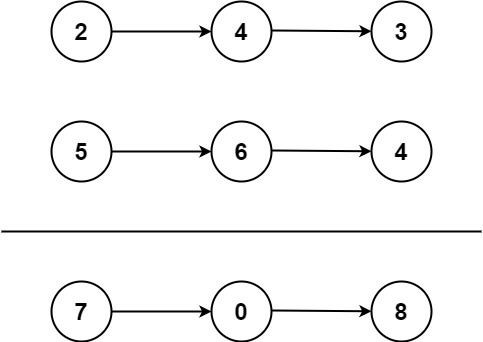
Input: l1 = [2,4,3], l2 = [5,6,4]
Output: [7,0,8]
Explanation: 342 + 465 = 807.
Example 2:
Input: l1 = [0], l2 = [0]
Output: [0]
Example 3:
Input: l1 = [9,9,9,9,9,9,9], l2 = [9,9,9,9]
Output: [8,9,9,9,0,0,0,1]
Constraints:
- The number of nodes in each linked list is in the range
[1, 100]. 0 <= Node.val <= 9- It is guaranteed that the list represents a number that does not have leading zeros.
Approach 01: Elementary Math
/**
 * Definition for singly-linked list.
 * struct ListNode {
 *     int val;
 *     ListNode *next;
 *     ListNode() : val(0), next(nullptr) {}
 *     ListNode(int x) : val(x), next(nullptr) {}
 *     ListNode(int x, ListNode *next) : val(x), next(next) {}
 * };
 */
class Solution {
public:
    ListNode* addTwoNumbers(ListNode* l1, ListNode* l2) {
        ListNode* dummyHead = new ListNode(0);
        ListNode* curr = dummyHead;
        int carry = 0;
        while (l1 != nullptr || l2 != nullptr || carry != 0) {
            int x = (l1 != nullptr) ? l1->val : 0;
            int y = (l2 != nullptr) ? l2->val : 0;
            int sum = carry + x + y;
            carry = sum / 10;
            curr->next = new ListNode(sum % 10);
            curr = curr->next;
            if (l1 != nullptr) l1 = l1->next;
            if (l2 != nullptr) l2 = l2->next;
        }
        return dummyHead->next;
    }
};
Time Complexity:
- O(max(m, n)): Assume that
mandnrepresents the length ofl1andl2respectively, the algorithm iterates at mostmax(m, n)times.
Space Complexity:
- O(1): The length of the new list is at most
max(m, n) + 1. However, we don’t count the answer as part of the space complexity.
# Definition for singly-linked list.
# class ListNode:
#     def __init__(self, val=0, next=None):
#         self.val = val
#         self.next = next
class Solution:
    def addTwoNumbers(self, l1: Optional[ListNode], l2: Optional[ListNode]) -> Optional[ListNode]:
        dummyHead = ListNode(0)
        curr = dummyHead
        carry = 0
        while l1 or l2 or carry:
            x = l1.val if l1 else 0
            y = l2.val if l2 else 0
            sum = carry + x + y
            carry = sum // 10
            curr.next = ListNode(sum % 10)
            curr = curr.next
            l1 = l1.next if l1 else None
            l2 = l2.next if l2 else None
        return dummyHead.next
Time Complexity:
- O(max(m, n)): Assume that
mandnrepresents the length ofl1andl2respectively, the algorithm iterates at mostmax(m, n)times.
Space Complexity:
- O(1): The length of the new list is at most
max(m, n) + 1. However, we don’t count the answer as part of the space complexity.
/**
 * Definition for singly-linked list.
 * public class ListNode {
 *     int val;
 *     ListNode next;
 *     ListNode() {}
 *     ListNode(int x) { val = x; }
 *     ListNode(int x, ListNode next) { val = x; next = next; }
 * }
 */
class Solution {
    public ListNode addTwoNumbers(ListNode l1, ListNode l2) {
        ListNode dummyHead = new ListNode(0);
        ListNode curr = dummyHead;
        int carry = 0;
        while (l1 != null || l2 != null || carry != 0) {
            int x = (l1 != null) ? l1.val : 0;
            int y = (l2 != null) ? l2.val : 0;
            int sum = carry + x + y;
            carry = sum / 10;
            curr.next = new ListNode(sum % 10);
            curr = curr.next;
            if (l1 != null) l1 = l1.next;
            if (l2 != null) l2 = l2.next;
        }
        return dummyHead.next;
    }
}
Time Complexity:
- O(max(m, n)): Assume that
mandnrepresents the length ofl1andl2respectively, the algorithm iterates at mostmax(m, n)times.
Space Complexity:
- O(1): The length of the new list is at most
max(m, n) + 1. However, we don’t count the answer as part of the space complexity.