
Given a binary tree and an integer k, determine the number of downward-only paths where the sum of the node values in the path equals k. A path can start and end at any node within the tree but must always move downward (from parent to child).
Examples:
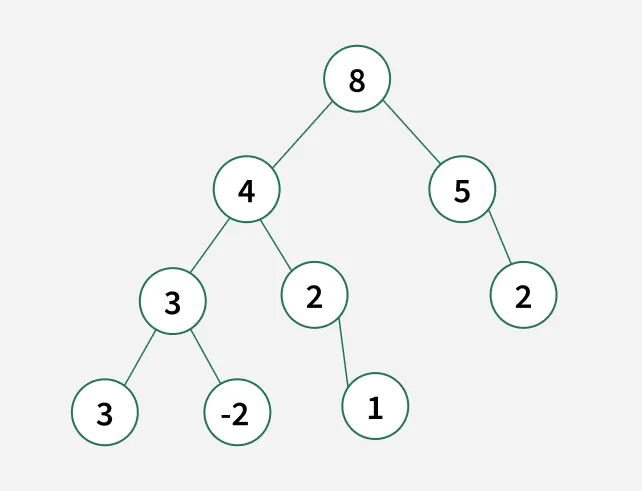
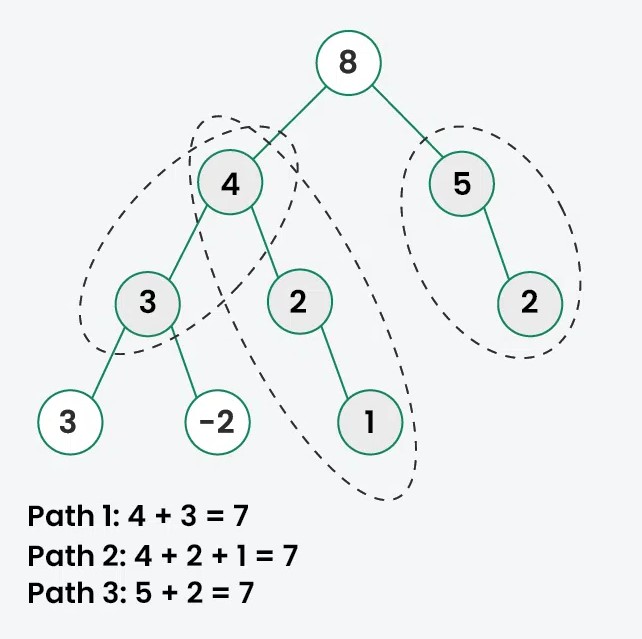
Input: k = 7

Output: 3
Explanation: The following paths sum to k
Input: k = 3
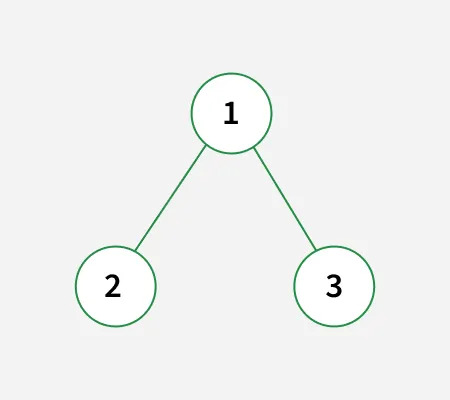
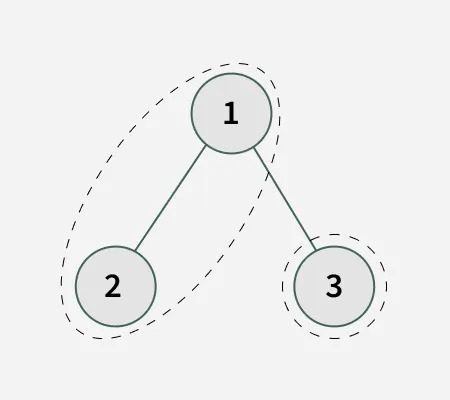
Output: 2
Explanation:
Path 1 : 1 -> 2 (Sum = 3)
Path 2 : 3 (Sum = 3)
Constraints:
- 1 ≤ number of nodes ≤ 104
- -100 ≤ node value ≤ 100
- -109 ≤ k ≤ 109
Approach 01:
-
C++
-
Python
#include <unordered_map>
using namespace std;

class Solution {
  public:
    void solve(Node* node, int currentSum, int targetSum, unordered_map<int, int> &prefixSumMap, int &pathCount) {
        if (!node)
            return;

        currentSum += node->data;

        if (currentSum == targetSum)
            pathCount++;

        pathCount += prefixSumMap[currentSum - targetSum];

        prefixSumMap[currentSum]++;

        solve(node->left, currentSum, targetSum, prefixSumMap, pathCount);
        solve(node->right, currentSum, targetSum, prefixSumMap, pathCount);

        prefixSumMap[currentSum]--;  // Backtrack
    }

    int sumK(Node* root, int targetSum) {
        int pathCount = 0;
        unordered_map<int, int> prefixSumMap;
        solve(root, 0, targetSum, prefixSumMap, pathCount);
        return pathCount;
    }
};
from collections import defaultdict

class Solution:
    def solve(self, node, currentSum, targetSum, prefixSumMap, pathCount):
        if not node:
            return

        currentSum += node.data

        if currentSum == targetSum:
            pathCount[0] += 1

        pathCount[0] += prefixSumMap[currentSum - targetSum]

        prefixSumMap[currentSum] += 1

        self.solve(node.left, currentSum, targetSum, prefixSumMap, pathCount)
        self.solve(node.right, currentSum, targetSum, prefixSumMap, pathCount)

        prefixSumMap[currentSum] -= 1

    def sumK(self, root, targetSum):
        pathCount = [0]
        prefixSumMap = defaultdict(int)
        self.solve(root, 0, targetSum, prefixSumMap, pathCount)
        return pathCount[0]
Time Complexity:
- Tree Traversal:
Each node is visited once, leading to a complexity of \( O(N) \), where \( N \) is the number of nodes in the tree.
- Prefix Sum Operations:
Each node performs constant-time operations (\( O(1) \)) involving the prefix sum map.
- Overall Time Complexity:
\( O(N) \), since each node is processed in constant time.
Space Complexity:
- Recursive Stack:
In the worst case (skewed tree), the recursion depth is \( O(N) \), while in a balanced tree, it is \( O(\log N) \).
- Prefix Sum Map:
In the worst case, the map stores a sum for each node, taking \( O(N) \) space.
- Overall Space Complexity:
Worst case: \( O(N) \), Best case (balanced tree): \( O(\log N) \).