
You are given a rectangular matrix, and your task is to return an array while traversing the matrix in spiral form.
Examples:
Input: matrix[][] = [[1, 2, 3, 4],
                  [5, 6, 7, 8],
                  [9, 10, 11, 12],
                  [13, 14, 15,16]]
Output: [1, 2, 3, 4, 8, 12, 16, 15, 14, 13, 9, 5, 6, 7, 11, 10]
Explanation:
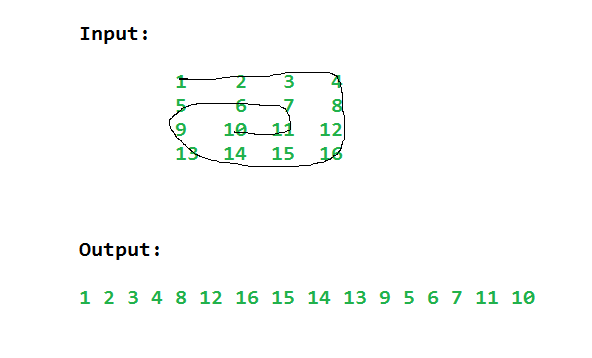
Input: matrix[][] = [[1, 2, 3, 4],
                  [5, 6, 7, 8],
                  [9, 10, 11, 12]]
Output: [1, 2, 3, 4, 8, 12, 11, 10, 9, 5, 6, 7]
Explanation: Applying same technique as shown above, output for the 2nd testcase will be 1 2 3 4 8 12 11 10 9 5 6 7.
Expected Time Complexity: O(n2)
Expected Auxiliary Space: O(n2)
Constraints:
1 <= matrix.size(), matrix[0].size() <= 100
0 <= matrix[i][j]<= 100
Approach 01:
-
C++
-
Python
#include <vector>

using namespace std;

class Solution {
public:
    vector<int> spirallyTraverse(vector<vector<int>>& matrix) {
        vector<int> result; // Vector to store the spiral order of elements
        int startRow = 0;    // Starting row index
        int startCol = 0;    // Starting column index
        int endRow = matrix.size() - 1; // Ending row index
        int endCol = matrix[0].size() - 1; // Ending column index

        while (result.size() < matrix.size() * matrix[0].size()) {
            // Traverse from left to right along the top row
            for (int col = startCol; col <= endCol; ++col) {
                result.push_back(matrix[startRow][col]);
            }
            ++startRow; // Move down to the next row
            if (result.size() == matrix.size() * matrix[0].size()) break;

            // Traverse from top to bottom along the rightmost column
            for (int row = startRow; row <= endRow; ++row) {
                result.push_back(matrix[row][endCol]);
            }
            --endCol; // Move left to the next column
            if (result.size() == matrix.size() * matrix[0].size()) break;

            // Traverse from right to left along the bottom row
            for (int col = endCol; col >= startCol; --col) {
                result.push_back(matrix[endRow][col]);
            }
            --endRow; // Move up to the previous row
            if (result.size() == matrix.size() * matrix[0].size()) break;

            // Traverse from bottom to top along the leftmost column
            for (int row = endRow; row >= startRow; --row) {
                result.push_back(matrix[row][startCol]);
            }
            ++startCol; // Move right to the next column
        }

        return result; // Return the spiral order of elements
    }
};
from typing import List

class Solution:
    def spirallyTraverse(self, matrix: List[List[int]]) -> List[int]:
        result = []  # List to store the spiral order of elements
        startRow = 0  # Starting row index
        startCol = 0  # Starting column index
        endRow = len(matrix) - 1  # Ending row index
        endCol = len(matrix[0]) - 1  # Ending column index

        while len(result) < len(matrix) * len(matrix[0]):
            # Traverse from left to right along the top row
            for col in range(startCol, endCol + 1):
                result.append(matrix[startRow][col])
            startRow += 1  # Move down to the next row
            if len(result) == len(matrix) * len(matrix[0]):
                break

            # Traverse from top to bottom along the rightmost column
            for row in range(startRow, endRow + 1):
                result.append(matrix[row][endCol])
            endCol -= 1  # Move left to the next column
            if len(result) == len(matrix) * len(matrix[0]):
                break

            # Traverse from right to left along the bottom row
            for col in range(endCol, startCol - 1, -1):
                result.append(matrix[endRow][col])
            endRow -= 1  # Move up to the previous row
            if len(result) == len(matrix) * len(matrix[0]):
                break

            # Traverse from bottom to top along the leftmost column
            for row in range(endRow, startRow - 1, -1):
                result.append(matrix[row][startCol])
            startCol += 1  # Move right to the next column

        return result  # Return the spiral order of elements
Time Complexity
- Traversal of Matrix Elements:
The algorithm traverses each element of the matrix exactly once in spiral order. Given that there are \( m \times n \) elements in the matrix, where \( m \) is the number of rows and \( n \) is the number of columns, the time complexity is \( O(m \times n) \).
- Overall Time Complexity:
The overall time complexity of the algorithm is \( O(m \times n) \).
Space Complexity
- Result Vector:
The result vector stores all the elements of the matrix in spiral order. Therefore, the space required for the result vector is \( O(m \times n) \), where \( m \) is the number of rows and \( n \) is the number of columns.
- Auxiliary Space:
The auxiliary space used for variables like
startRow,startCol,endRow,endColis constant, i.e., \( O(1) \). - Overall Space Complexity:
The overall space complexity is \( O(m \times n) \) due to the result vector.